
Chilblains
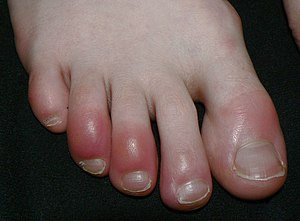
- Image via Wikipedia

Chilblains are associated with cold winter conditions, often worsened by wet weather.
So as I go off to the Cape for a few days I’ll give you some suggestions to protect against ‘winter feet’.
Chilblains affect all age groups and both sexes, but girls and women do seem to suffer more.
Keep your feet warm and dry. Avoid socks with synthetic fibres, that can make your feet sweaty and cold.
Some modern fibres ‘wick away’ sweat, but you can get cold. Try a pair of mohair socks – Visit the Cape Mohair website.
If you are sitting for some time, try wrapping your legs in a loose-fitting blanket(think of the bottom of a sleeping bag).
Do wriggling and waggling exercises to keep the circulation moving in your leg muscles. Don’t sit for long periods, because if you have a sluggish circulation it makes it worse.
STOP SMOKING! The spasm or constriction of your blood arteries from ONE cigarette lasts 6 hours.
Take regular walks in well-fitting shoes. Tight shoes press the blood out of your toes. Thicker sole are important to protect your feet from the cold and wet. Boots are good but high fashion ones often don’t keep your feet warm.
Chilblains are the result of a defective response to a cold stimulus. For example: when you take the chicken out of the deep freeze, the nerves in your fingers send and receive a message which causes the nerves to the blood vessels to shut down to protect the fingers from the cold.
When you have the chicken out on the kitchen worktop and you are back in the normal temperature the reverse messages happens, and you get a bit of a tingling feeling as the blood flow returns to normal.
If this system has a delayed response – for whatever reason – the fingers remain cold, because the blood is lacking oxygen. Soon the body recognises this as abnormal and tries to fix it with an inflammatory response.
This can settle things with just a little swelling and pain in the fingers, but usually this process ends up with red, painful, swollen fingers, which look like cocktail sausages.
In some cases, this process is the result of a significant vascular disease, for example – Raynauds Syndrome(or Phenomenon). If you suffer from this you will know and should be havinr treatment – it is characterised by spontaneous spasm of the blood vessels of the hands – where you get an unexpected cold finger or fingers, at any time of year, but especially in winter.
Treatment for chilblains is difficult and usually centres around prevention. Shoes, socks and footwear as I have said.
There are some medicines prescribed by doctors called Vaso-dilators, but often topical preparations such as Thrombophob or Reparil Gel are tried.
Some Homeopathic preparations include Vitamin A and Nicotinic Acid which act as circulatory stimulants. Getting into a warm bed helps – but don’t sleep with your feet up against a hot water bottle!
As I write this in Hout Bay, I’m happy to report that it has been a beautiful sunny and dry day.
Take care of your pair. No more smoking. Regular exercise. Keep chilblains away this winter.
![Reblog this post [with Zemanta]](https://i0.wp.com/img.zemanta.com/reblog_e.png)
Ingrown Toe Nails

- Image via Wikipedia

More people are complaining about their ingrown toe nails as winter comes and closed shoes are being worn more.
The most common cause of an ingrown toe nail is poor self-treatment, but there are numerous other factors, divided into intrinsic and extrinsic.
Common intrinsic(internal) factors are the basic shape of the nail – especially at the edges – we all have different curvatures and angles and some nails have increased curvature on one side only.
Another factor is the structure and function of the foot (the biomechanics). If a flexible foot rolls or flattens excessively toes can rub against each other, causing pressure. Other factors can be sweaty feet and thin skin, caused by age, medication or circulation.
However, it is the extrinsic factors that really produce the problems – poor self-cutting and shoe pressure top the list. (Sometimes even health care professionals and therapists can cause ingrowns!), tight socks and injuries can also be added to this list.
In the clinic, the appearance of ingrown toe nails varies from a small pink swelling, to an inflamed growth or ‘proud flesh’, like a small cherry, lying over the nail plate. The pain seems to depend on the individual’s pain threshold more than the condition itself.
The offending nail can be just a small ‘shoulder’, pressing into the sulcus or a sharp spike of nail which penetrates the skin. The skin tries to heal itself when a spike penetrates it and that process leads to the formation of ‘proud flesh’ or hypergranulation tissue. Of course if the toe becomes infected then pus is also present.
Treatment for ingrown toenails varies with the cause and duration. The simplest treatment is correctly cutting out the offending portion of nail. In the more painful and complicated cases this is done under a local anaesthetic.
The permanent solution under local involves an operative procedure where the complete side of the nail including the matrix, is cut out and the matrix space is destroyed with a strong caustic. After about a month the side where the nail was looks normal – the cavity heals completely. This is a procedure that podiatrists do very well as an outpatient procedure.
Obviously avoiding ingrown nails is the best, but nobody should suffer with them when skilled podiatric care is available.
May is World Foot Health Awareness Month
World Foot Health Awareness Month will be celebrated at the Wits Donald Gordon Medical Centre on Thursday 28th May.
From 09.00 to 12.00 noon, people with diabetes and their families are invited to listen to a talk on diabetes by Dr David Segal and one on the diabetic foot by podiatrist Tracey Johnson. This will be followed by an opportunity to ask questions about diabetes and feet.
If you have diabetes or are family of someone with diabetes – this is for you – so be there!
Sponsored by Sanofi-Aventis; supported by Diabetes SA, I will be there with my colleague Tshidi Tsubane to answer questions too.
POORLY FITTING FOOTWEAR IS A MAJOR CAUSE OF FOOT ULCERATION
Traction Apophysitis and Heel Pain
Heel pain as a result of [Traction Apophysitis->@case-histories] is usually debilitating. I wrote about this on 3 April, 11 February and 8 February. The progress report and full case history is now on the website under [Case Histories->]. Although this section is of greater interest to other health professionals, have a look at the X-ray pictures.
They were reported as normal – we could debate that – but what IS important is the improvement in the state of the bone after 3 months of care.
MAY IS WORLD FOOT HEALTH AWARENESS MONTH
May is World Foot Awareness Month – Diabetes & Crocs
Foot Health Awareness is vital for people with diabetes.
PEOPLE WITH DIABETES ARE 25 TIMES MORE LIKELY TO LOSE A LEG THAN PEOPLE WITHOUT THE CONDITION
Today I want to issue a timely reminder to people with diabetes who want to wear ‘Crocs’.
Last Friday, I saw a patient who “lived in her ‘Crocs’.” That was until she got splinters which penetrated the soles and stuck into her big toe, as she was walking across the university campus. The splinters were removed by her GP and today she told me there was a small remaining piece that also had to be removed. Fortunately, although she has neuropathy, the wounds are healing well.
Last Christmas, a family member (with no diabetes) also had a piece of metal go through the sole of his ‘Crocs’, whilst walking across the garden.
Previously, I have not taken a strong stand on this, but these two events have prompted me to express my opinion in the form of a WARNING.
If you have diabetes, think very carefully about wearing ‘Crocs’. If you have poor circulation or reduced nerve sensation; do not wear them outside the home.
EVERY 30 SECONDS A LOWER LIMB IS LOST TO DIABETES SOMEWHERE IN THE WORLD
Closed Kinetic Chain Exercise for Joint Rehabilitation – Jump for Joy!
Closed Kinetic Chain Exercise for Joint Rehabilitation was the title of a Rehabilitation Workshop that I was invited to yesterday. It took place at the University of the Witwatersrand Sports Science Institute and introduced me to Reboundology and a quite extraordinary piece of kit called Kangoo Jumps.
Kangoo Jumps are a Swiss designed boot that almost defies description – the nearest that I can come to is – a Ski boot with an oversized doughnut lying on its side as a sole!
They have the ability to reduce the impact force to the ground by up to 80%. This patented Impact Protection System utilises the principles and practice of closed chain kinetics.
Basically, the difference between open and closed chain kinetics is that in open chain there is still some movement in part of the limb, this allows additional twists or rotations to affect other body parts. In the closed chain, the part is stabilised (eg foot or hand) against a hard surface. It’s actually more complicated, but this is what I understand at present.
Rebound exercise is different due to the following factors: During rebound exercise; We are opposing gravity and acceleration: Acceleration in the vertical plane develops a greater G-force: All these forces come together at the bottom of the bounce: Cells have to work harder to maintain their position in space: This explains why trampolinists have extra unexplained strength.
Kangoo Jumps utilise these principles by allowing you to jump up and down, whilst concentrating your body weight through your centre of gravity.
I was able to test the theory in practice when we were put through an exercise session. I had a great time bouncing around the gym, being guided in various exercises. The first thing I became aware of was that my posture improved immediately, I stood up straighter and my core lower abdominal muscles were getting a workout! My heart rate went up quite quickly too. In addition, yesterday and more importantly, today, I don’t have any muscle soreness or stiffness.
Where you will be asking is the Science? There have been many studies worldwide, but there is ongoing research underway at the University of the Witwatersrand. Have a look on the website www.kangoojumps.co.za
Reboundology has also been the subject of considerable research by N.A.S.A
The application of this technology is for rehabilitation as well as strengthening. (You would be surprised who is using them!) For example they will improve balance, co-ordination and agility; improve foot alignment; increase overall muscular tone. They stimulate cellular bone rebuilding ability. The potential application in managing arthritis is an exciting thought.
Closed chain kinetics using Kangoo Jumpssseems to me to be offering a new clinical modality and challenge to our current way of thinking. You can be any age from 6 to 90! I can’t wait to start rebounding!
May is World Foot Health Awareness Month: Baby Walkers
Today’s Foot Health Awareness Tip: Avoid Baby Walkers.
Children will decide to walk independently when their bodies are able to. Baby walkers place extra stress on joints before nature intended. In addition they cause the foot and lower limb to move in an unnatural walking pattern.
Research has shown the use of baby walkers is associated with a delay in normal walking and activites such as standing and crawling.
Their use is best avoided – they are banned in Canada.
Source: Children’s Feet. Gordon Watt. Lecturer in Podopaediatrics, Glasgow Caledonian University and Consultant Podiatrist, Royal Hospital for Sick Children, Glasgow. Society of Chiropodists and Podiatrists, UK.
May is World Foot Health Awareness Month
The International Fedaration of Podiatrists, headquartered in Paris, France, has declared May to be World Foot Health Awareness Month. I join them in calling the attention of the public and health care providers to the importance of good foot and ankle care. It’s time for all South Africans to stop and take a look at their feet!
The importance of good foot health and the role played by the podiatrist cannot be overstated, since, most South Africans will develop some foot or ankle problem during their lifetime. World Foot Health Awareness Month is a marvellous opportunity to stop and consider the value and importance of our feet.
Winter is nearly here and we will be spending more time in closed shoes. Do last year’s boots really still fit? Are they going to cause pressure calluses?
Don’t wait for your foot problem to become severe. Remember that the average person takes about 8,000 to 10,000 steps per day and while you’re walking, your feet are taking a pounding; often enduring more than your body weight with each step.
As part of World Foot Health Awareness Month 2009, there is a special focus on Diabetes and the Diabetes Health Care Team. In support of this initiative, the South African Diabetic Foot Working Group (DFWG), will be presenting free patient-oriented symposia nationwide.
PRETORIA:
30th May. Contact: Andrika Symington: 012 548 9499
CAPE TOWN:
9th May.Contact: Anne Berzen 072 342 9558
BLOEMFONTEIN:
13th June. Contact: Dr Willem de Kock 082 379 6231
DURBAN:
to be confirmed. Contact: Dr Paruk 031 241000-ask for speed dial
JOHANNESBURG:
to be confirmed. Watch this space!
These symposia will offer a unique opportunity for people with diabetes and their families to ask questions of the members of the health team directly involved in foot care.
MAY 2009 is WORLD FOOT HEALTH AWARENESS MONTH
Bunion Surgery – A Painful Choice
Deciding to have bunion surgery can be one of the most difficult health decisions to make. ‘Bunions’ are a cause of distress to many thousands of people -mostly women -worldwide. Last year, I wrote about bunions and my opinion was and still is – “avoid bunion surgery if at possible, unless it is ruining your life and crippling you with pain”.
The ‘bunion’ referred to here is the bony deformity characterized by a big toe that deviates towards the rest of the toes, possibly accompanied by a second toe which is bent and overlies it.
When any surgical intervention is considered, be it the podiatrist enucleating a corn, removing part of a toe-nail or the orthopaedic surgeon realigning the foot in bunion surgery, all of us strive to do our best to achieve a satisfactory outcome, by exercising our skills to the utmost.
So you can imagine my concern to have two patients recently complaining bitterly about their unhappiness with the result of their bunion surgery. Add to this my surprise at the ‘twenty-something’ who wants surgery because she doesn’t like the look of her feet and her bunion (this one is the small thickening of the metatarsal bone with no deformity), prevents her from wearing the high fashion shoes she needs for work.
What can you say to a middle-aged, active woman who decided to have her bunion (deformed type) corrected, but after three months can only wear trainers with the toe cut out, has a swollen foot, pain and discomfort, difficulty driving, plus all the associated emotional stress? Or how do you respond to a similar woman who is now in constant pain and has had altered her walking style because the foot is rigid at the big toe joint?
To the best of my knowledge the procedures were technically successful and there is no deformity anymore. In addition we all react differently to a surgical “assault” and time does allow better healing. Also, there are numerous variations of operations and techniques available for bunion correction surgery.
Firstly – go back to the surgeon and discuss your options.
Secondly – see if a podiatrist can assist with biomechanical correction or alignment and footwear advice.
With my 2 patients, one has had orthotics made and the other I referred to the surgeon, who has recommended further physiotherapy, with the possibility of another operation to remove the steel plate that is in the foot.
I will still refer patients who meet my criteria outlined above for consideration for surgery, because the final decision to undergo sugery is always taken by the patient. Unfortunately, there can be no absolute guarantees since the structure of each foot is so complicated.
So what to do about ‘bunions’? Is there an underlying systemic disease such as rheumatoid arthritis?
We must consider the patient’s age. Is the patient overweight? What is the biomechanical structure and function, not only of the feet but lower limbs and body? Have all possible conservative measures such as night splints, orthotics, insoles, appropriate footwear, been exhausted?
Be guided by the severity of loss of function, pain, discomfort and limitation of daily activities. Will the patient be able to adhere to all the post-operative requirements, expected by the surgeon?
Eventually, all these factors (plus others), must be seriously thought about before undergoing bunion surgery.
Foot Fit for Voting?
Are you ‘foot fit’ for voting? On Wednesday of this week South Africans go to the polls to elect a new government. Foot fitness could be important since the process can involve many hours of extra standing or walking.
Here are a few tips to help you through the day!
Try to get a lift to the polling station – this reduces the walking you have to do.
Take a folding chair or sit on the ground if your feet start to ache.
Wear comfortable shoes with thicker soles – trainers or lace ups are best, because they can be loosened if your feet and ankles start to swell.
Don’t stand in one position for too long – move from foot to foot, wriggle your ankles up and down to keep the circulation going.
Bend gently from the knees up and down a few times.
If you have diabetes and reduced sensation take extra care that you don’t rub a blister from your shoes.
Start talking to the people around you – it helps to pass the time!
(Try to avoid talking politics!).
Have something to eat before you go to vote. (Voting on an empty stomach is as risky as shopping on an empty stomach!).
Sometime it’s a good idea to go later to the polling station, since everyone wants to get there early!
Above all do vote. Remember that it is a Public Holiday, so rush home and put your feet up.